The hour that never made it onto an invoice
by Daniel Rockenschaub3 min read
An hour nobody logs directly against the job rarely makes it onto an invoice. Why that costs more than any time-tracking software — and what changes when the timer rides along on the phone.

The technician is on site at seven, back in the van by four. In between: driving, picking up material, the actual work, an extra task the customer asked for on the spot. By the end of the day there's a slip of paper in the glovebox — or nothing at all, because the hours only get reconstructed from memory on Friday.
That works for a while. Until Tuesday's extra work is missing from theinvoice, because by Friday nobody remembers it clearly enough.
How you notice hours are getting lost
A few signs repeat in almost every business that still tracks hours onpaper or from memory:
- Hours get entered in a batch at the end of the week instead of while the work happens.
- The invoice is missing exactly the extra work that came up on the spot and was never written down anywhere.
- Asked "how many hours are in this job so far?", nobody has a quick answer.
- When two employees worked the same job, it's unclear afterwards who was there for how long.
- By month's end, it's unclear which hour was billable and which wasn't.
On its own, none of this stands out. Over a year, these are the hours thebusiness actually worked but never billed.
What it actually costs
Not time tracking itself — a simple time clock is cheap. What's expensive is the hour nobody bills anymore because three weeks later it can't be tied to a specific job. Over a year and a whole team, that's not a rounding error —it's a hole in the calculation.
The cheapest hour of labour a business has is the one it no longer bills.
A simple check
For one week, alongside the existing process, write down: is an hour logged while it happens, or only later, from memory? And for each hour, is it clear which job and which employee it belongs to? Most businesses find more gaps in that week than they expected.
To be fair: a business working purely from an office, with fixed hours and no changing job sites, usually doesn't have this problem. The effort pays off where work happens on the road and needs to be billable.
How this looks in Nexoro
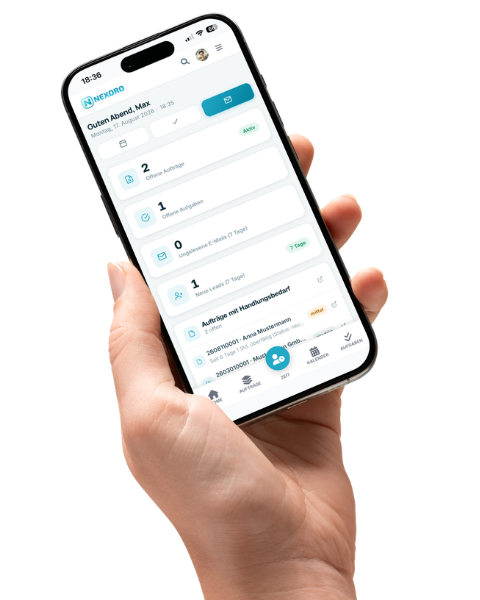
Nexoro deliberately keeps two systems separate, on the same underlying data:a live timer that runs directly against a job or a task, with a work type, a note and its own billable flag — startable from the phone, including aroute button to Google Maps for the drive to the next appointment. No credentials are stored on the device; the app stays signed in via the webcookie. Alongside that sits the monthly close: daily target vs. actual hours, Austrian public holidays, a running annual carryover and two-stageleave approval. The work-hours record comes straight out of the job as a PDF at the end — the basis for the invoice, not a guess at one. If you want to check how many hours are slipping between work and invoice in your business, tell us and we'll work through it together.