The meeting starts in five minutes — and you're in the van
by Daniel Rockenschaub3 min read
A meeting normally needs a second program, a second account and a link you have to go looking for. Why the conversation is better off happening where the customer, the job and the history already are.

Half past one, country road, twenty minutes to the next site. The call with the customer is at two. The link is in an email, the email is in a mailbox, and the program that wants to open that link was never installed on the workphone.
It almost always ends the same way: you phone instead, apologise, and have someone tell you afterwards what was discussed. The conversation happened —just not with everyone who should have been there, and not written down anywhere.
How you notice the meeting itself is in the way
A few patterns repeat in businesses whose people aren't at a desk all day:
- The join link gets emailed, forwarded, pasted into the chat — and five minutes before the start, someone is still hunting for it.
- Every conversation demands an extra program that wants to be installed, updated and signed in. On the technician's phone it is neither.
- Anyone on the road doesn't join at all, and waits for a summary nobody writes.
- After the meeting, nothing anywhere records that it happened: no entry on the job, no note, no outcome.
- The phone call, the video call and the chat about the same customer sit in three different places — and none of them is the job they were about.
On its own it's a minute each time. Together, it's the conversations that end up being had twice.
What it actually costs
Not the half hour of talking — that was planned for. What's expensive is what's missing afterwards: the customer calls the next day, and whoever picks up knows nothing about yesterday's agreement. The appointment gets made a second time, because half the people were on the road the first time. And the decision that was taken in the meeting gets reopened three weeks later, because nobody is sure any more how it ended.
A conversation recorded nowhere is a conversation you'll have to have again.
A simple check
Two questions are enough. First: how many steps sit between "I'm in the van" and "I'm in the call"? Open the app, find the link, launch the second program, type in the code, confirm the account — every one of those steps is a chance to give up. Second: a week later, where does it say that this conversation took place, and what came out of it?
To be fair: a team that sits at the same desk all day with two scheduled meetings a week barely notices any of this. The problem belongs to businesses whose people move between site, customer and office — and whose conversations therefore keep starting halfway down the road.
How this looks in Nexoro
Video, phone and chat aren't bolted-on extras in Nexoro, they're part of the same system. Video conferencing runs on Nexoro Meet, a self-hosted product of its own at `meet.nexoro.net`, embedded directly in Nexoro — no second account, no separate program. Telephony belongs to it just as much: Nexoro provisions SIP extensions on 3CX or Asterisk/FreePBX, logs incoming and outgoing calls against the contact, keeps call notes, and pops up the matching customer when the phone rings. Dialling happens with one click from the customer, the contact or the job.
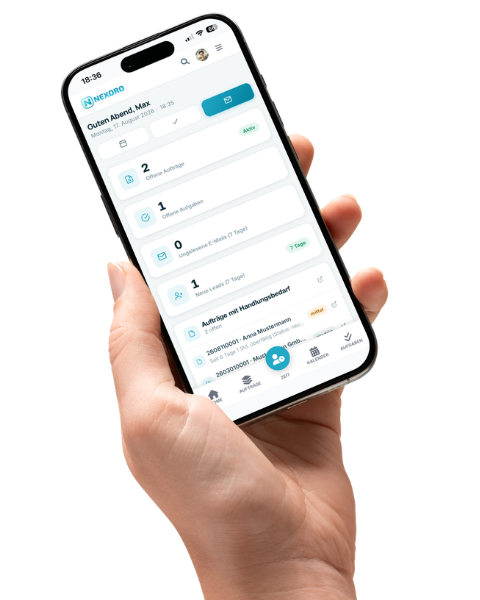
What matters is what happens afterwards: every call, every email, every status change lands automatically in the job's history, alongside the Korochat thread. Three weeks later, anyone who wants to know what was discussed with this customer opens the job — not four programs. The same holds on theroad: the mobile app shows the same interface with its own navigation, you stay signed in, and no credentials are stored on the device itself — in case the phone stays behind on site.
If you want to know what that looks like for you, tell us how many programs currently sit between you and your next customer conversation. Usually it's three.