Eight tools for one job
by Daniel Rockenschaub3 min read
Quotes in Word, customer data in Excel, appointments on a phone, hours on a slip of paper in the van. It works for a surprisingly long time — until the first job slips through. Five signs there are too many programs in play.

A job rarely starts in one program. The customer calls, the number stays insomeone's phone. Prices arrive as a PDF from the wholesaler. The quote iswritten in Word, customer data lives in Excel, the appointment goes into aphone calendar, the follow-up question runs over WhatsApp, and the hours endup on a slip of paper in the van. At the very end someone writes the invoice— typing the same address for the fourth time.
It works. For a surprisingly long time. Until the first job slips through.
How you notice there are too many
Five things come up in nearly every conversation with trade and service businesses:
- The same data gets typed again and again: the customer address into the quote, the delivery note, the invoice.
- Asked where a job stands, the answer is "let me check" rather than an actual answer.
- Important agreements sit in a WhatsApp thread that exactly one person has on their phone.
- Follow-ups happen when someone remembers them, not because a system suggests them.
- When a colleague is off sick, it isn't only their labour that's missing — half the process goes with them.
On its own, none of this is a problem. Together they are the reason Friday afternoon disappears into paperwork.
What it actually costs
Not the licence fees. Those are usually the smaller part. The expensive part is the handovers: every time a piece of information is carried from one program into the next, it costs time — and every time, a little of it gets lost. The call that never makes it onto the job. The promise made on site that nobody writes down. The hour nobody can account for three weeks later.
The biggest gain is rarely more software. It is fewer handovers.
An exercise before switching
Before comparing systems, something unglamorous helps: write down one typical job from enquiry to payment — and next to each step, note which program it happens in. Done honestly, most businesses end up with six to ten stations.
After that, the question is no longer "which software does the most?" but: which of these stations disappears? A system that keeps the quote, the job, the appointment, the call, the hours and the invoice on the same record doesn't save time by being faster. It saves time because the handover is gone.
To be fair, this doesn't pay off for everyone. Manufacturers need bills of materials and production planning, and other systems are built for that. If you only plan projects, a board will serve you well. The effort pays off where a job passes through many hands.
How this looks in Nexoro
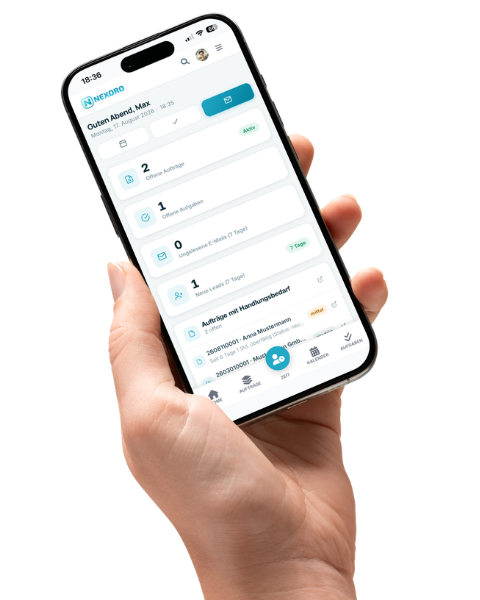
That is exactly what Nexoro is built for: customer, quote, job, tasks, calls, documents, hours and invoice all hang on one record — in a dedicated instance with its own database per company. If you want to know whether that fits the way you work, send us your typical job and we will walk through it together.